What’s Meant for You
We often speak about destiny as though it removes us from the equation.

One of the most common phrases I’ve heard throughout my life is:
“What’s meant for me will never pass me by.”

It’s one of those rare ideas that seems to exist everywhere. People from different cultures, different religions, and different walks of life often agree on.
And I do too.
What I disagree with is how often it’s misunderstood.
Some people speak about destiny as though it excuses them from participation.
They want the opportunity, but not the risk.
They want the blessing, but not the vulnerability.
They want the outcome, but not the action required to reach it.

As though what is written for them will somehow survive every poor decision, every act of pride, every refusal to act, and every door they close with their own hands.
That isn’t faith.
That’s passivity.
In Islam, we’re taught to tie our camel and then place our trust in Allah.
The order matters.
Tie your camel first.
Trust second.
Action first.
Reliance second.
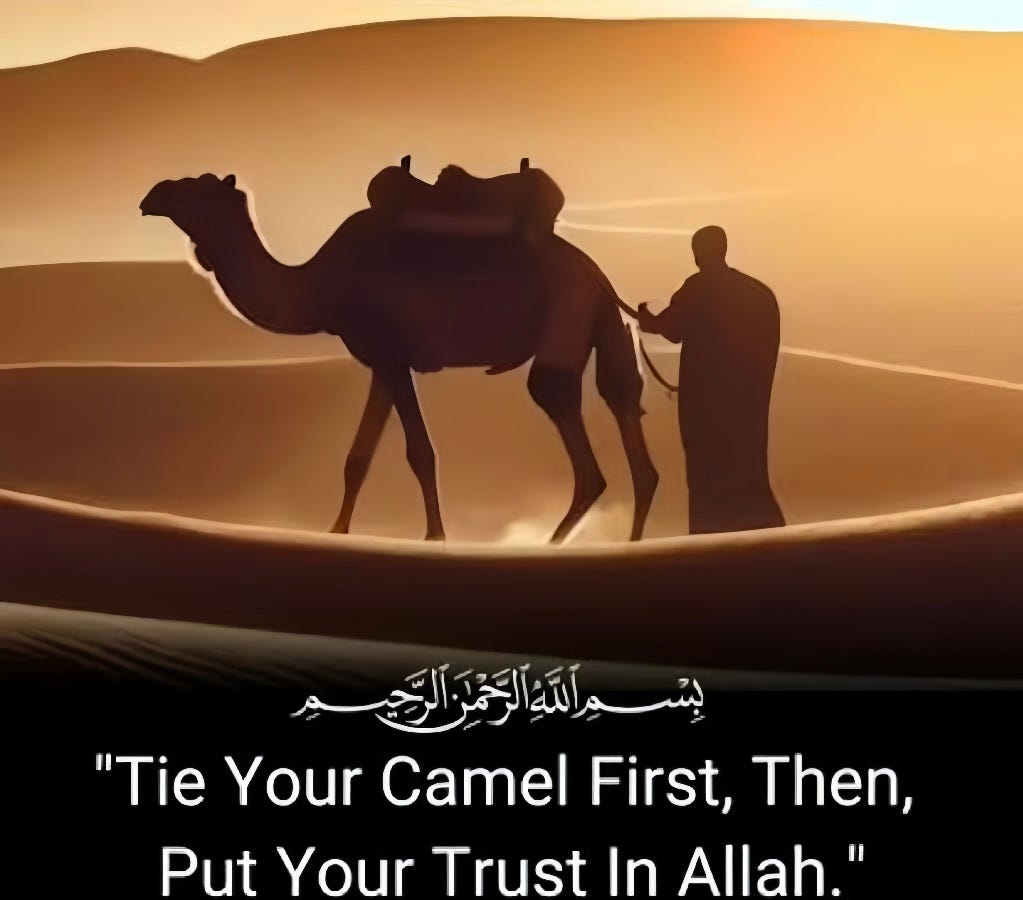
Faith was never intended to replace effort. It was meant to accompany it.
I’ve noticed that many people hide behind the language of destiny when what they’re really protecting is their ego.
For example, someone meets a person they genuinely like.
The attraction is there.
The compatibility is there.
The opportunity is there.
Yet instead of being honest, they decide to play games.
They become distant.
They pretend not to care.
They withhold affection.
They convince themselves that if it’s truly meant to be, the other person will stay.
But the other person has free will too.
Not everyone is willing to play.
Not everyone interprets mixed signals as interest.
Not everyone is interested in chasing someone who is pretending to run away.
Some people simply walk away.
Then the person who created the distance comforts themselves with the familiar phrase:“Well, if it was meant for me, it wouldn’t have passed me by.”
But they participated in the outcome.
Their choices mattered.
The same pattern appears everywhere else in life.
People refuse to apologize because their pride won’t allow it.
They refuse to express gratitude.
They refuse to admit they were wrong.
They refuse to tell someone how they feel.
They refuse to ask for help.
Then they wonder why certain doors remain closed.
What I’ve learned is that pride rarely looks the way we imagine it.
It isn’t always loud.
It isn’t always arrogant.
Sometimes it looks stoic.
Sometimes it looks detached.
Sometimes it disguises itself as strength.
But underneath it is often the same fear:
“What if I get hurt?”
So people protect themselves.
They build walls.
They become unreadable.
They offer nothing.
Then they expect connection.
They hand people a stone and expect warmth in return.
They offer distance and expect closeness.
Silence and expect understanding.
Pride and expect love.
Life doesn’t work that way.
God gave us free will.
That means we’re constantly being presented with choices.
Doors open.
Paths appear.
Opportunities arrive.
People enter our lives.
And then we choose.
Perhaps what is meant for you will find its way to you. But when it arrives,
you still have to recognize it.
You still have to participate.
You still have to walk through the door.
Because sometimes the opportunity wasn’t lost because it wasn’t written for you.
Sometimes it was lost because your pride convinced you that you didn’t have to reach for it.